Family Research Publications

Access reports and white papers with insights and frameworks that shape best practices for family enterprises from our network of leading professionals.

Latest family research articles and papers

Explore Our Latest Case Studies and Publications

July 2025
Jen, M., Li, G., Gan, J., and Ng, F. W.
FO Ecosystem 2.0: Deepening Hong Kong's Position as a Leading Hub for Family Offices

This booklet presents key insights from an in-depth study on Hong Kong’s evolving Family Office ecosystem. As the city positions itself as a leading global family office hub, this report outlines strategic recommendations to strengthen its competitiveness, deepen its cultural relevance, and future-proof its role in global stewardship.

2024
Chen, X., Au, K., Cheng, J., & Ng, F. W.
Who can facilitate innovation in family firms? Evidence across institutional contexts

2022
Rodrigo Basco , Albert E. James , Nupur Pavan Bang , Andrea Calabrò , Jeremy Cheng , Luis Díaz-Matajira , and Georges Samara
Conclusion: The lessons learned

When we read books, we often rely on the conclusion to help us gain insights into what the authors’ intended message of the book is. It is a way to establish a conversation with the authors and to confront ideas learned. As we thought about what our message should be it seemed appropriate that it should be about learning. After all, our Casebook’s central aim is that cases based on real family businesses from around the world are a useful tool in educating, teaching, and training family business members. To this end, we, as editors, reflected on what we had learned from the cases we handled and how these insights might impact our future dealings with students, business families, and advisors. What follows are the lessons learned from the process of collecting, sorting, and packaging the family business stories presented in this Casebook.

2022
Chung, H. M., Au, K., & Thomsen, S.
Beyond Charity: Family Foundations Perpetuating Longevity of Family Businesses

Family foundations are prevalent, but seldom have researchers examined its function and influence as an ownership vehicle for family businesses. This paper advances an institutionalized reference-point theory to explain family foundation’s role on perpetuating family business. The theory posits that these foundations cultivate family members long-term commitment to corporate responsibility which enhances the identification and socio-economic wealth creation of business families. In a longitundinal study of public-listed family businesses (1996-2016) in Taiwan using survival analysis, the presence of family foundation not only itself promotes, but also, as a moderator, heightens the positive effect of family ownership on longevity of family firms. Qualitative evidence from interviewing professional accountants affirmed that family foundations strengthened the identification of members to the family businesses. Further, while their purpose was for charity and not control of the business, establishing the foundation shifted family members’ orientation for the long-term, which resulted in longer survival.

2022
Cheng, J., Calabrò, A., Díaz-Matajira, L., Bang, N. P., Basco, R., James, A. E., & Samara, G.
Family business case learning: How to maximize learnings from this STEP Project Global Casebook

How can we learn from family business cases? Every day we come across stories about very successful family businesses in our community and stories about feuding families that fight until the end for a piece of wealth that destroys the family fold. Business families like to learn from their peers by extracting good practices and avoiding fatal mistakes that others incur. Advisors are often asked to share real cases on how to build a future-proof succession plan or a family governance structure that can secure a harmonious and prosperous future for their client families. Family business scholars want to share intriguing stories in their class, while taking the opportunities to identify “unexplained” phenomena and build better theories to explore them.

2022
Calabro, A., Au, K., McGuinness, T., & Fong, S
The regenerative power of family businesses: Transgenerational entrepreneurship. Global family business report: Country benchmarking data – Hong Kong (SAR)

What is it about family businesses that enables them to stay ahead of the competition? What is the secret to their staying power and their capacity to grow successfully from decade to decade and from generation to generation? And how do they continue to nurture and sustain their founders’ entrepreneurial spirit?

2022
Jen, M., Cheng, J., Au, K., & Chen, K. X.
DC International: riding out of disruption as a third-generation successor

It was not a tenure that Ronald Chan, a third-generation member of the family-owned DC International, had ever expected. Dan Chee, or bicycle, not only formed part of the company name but also supported three generations of the Chans. Ronald’s return to his family’s bicycle distributor and retailer was greeted by years of unforeseen waves of disruptions, from the globalized markets and supply chains to the social unrest in Hong Kong and the COVID-19 pandemic. DC International’s sales had plunged by nearly 50 per cent in five years, and Ronald knew he had to come up with a new plan to secure the future of his 70-year-old family fold. While his father, Kenneth Chan, and his uncle, Stephen Chan, endorsed his aggressive plan to build a home-grown premium bicycle brand, he pondered how he could finance this revital- ization project when the pandemic hit hard on the economy. Ronald saw interests from DC International’s loyal clients to invest in this, but he was not totally sure how he might mitigate risks associated with the family reputation. He also wondered how he should position the new brand as the pandemic largely suppressed the high-end market but boosted the sales of the lower-end bicycles.

2022
Bang, N. P., Samara, G., Basco, R., Calabrò, A., Cheng, J., Díaz-Matajira, L., & James, A. E.
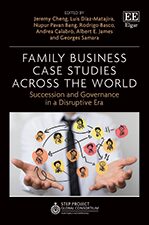
Family Business Case Studies Across the World: Succession and Governance in a Disruptive Era

This book presents a unique collection of case studies from across the globe to create a comprehensive understanding of how family firms can respond to future disruptions. Each case contains learning notes with objectives, discussion questions and suggested readings to facilitate learner understanding and engagement with the topic. Cases on topics such as global succession and governance practices will aid strategic decision-making capabilities in family businesses and will also benefit practitioners in these areas.

2022
Cheng, J., Au, K., Widz, M.,&Jen, M.
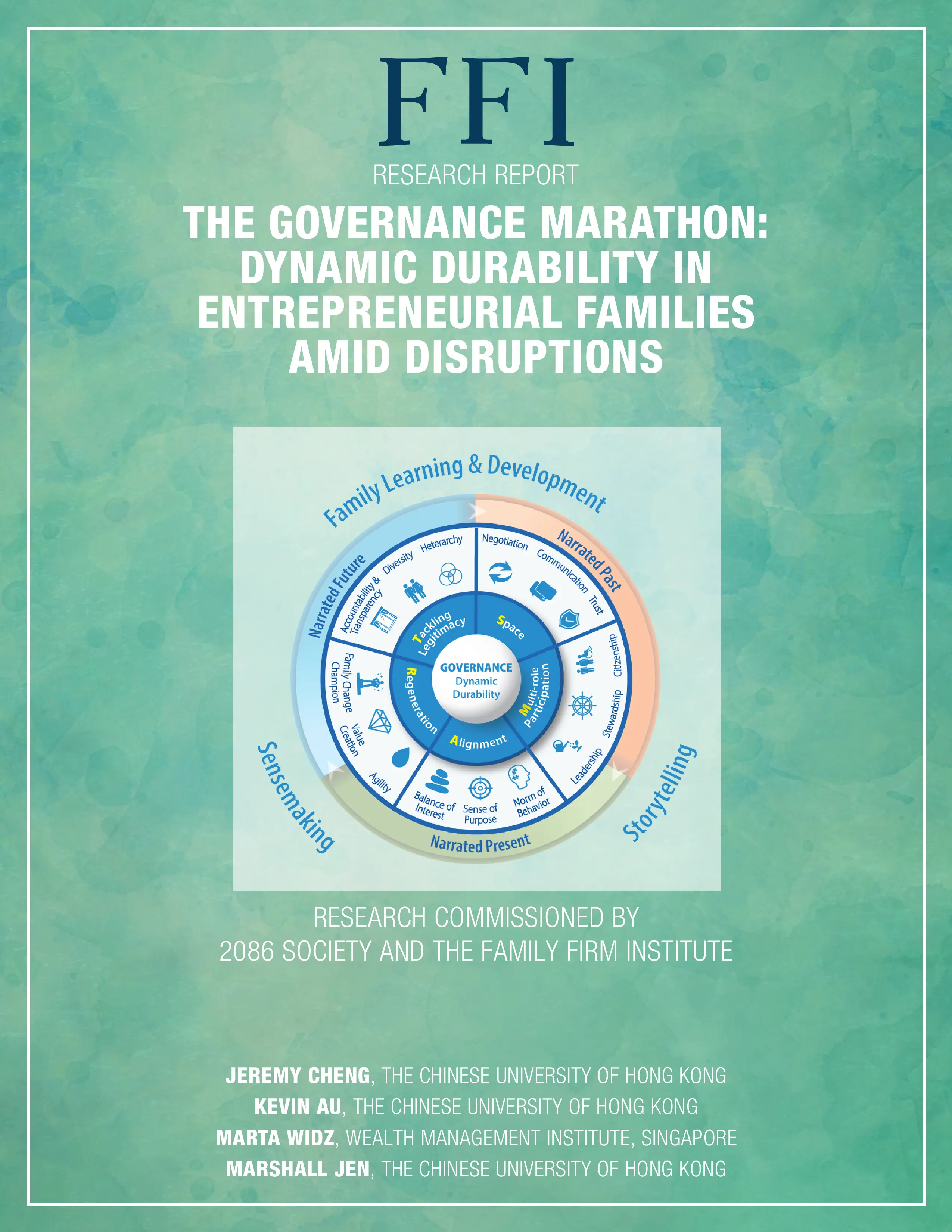
The Governance Marathon: Dynamic Durability in Entrepreneurial Families Amid Disruptions

This research addresses how entrepreneurial families nurture a durable governance system in the ongoing waves of external and internal disruptions. Entrepreneurial families live in a pattern of disruption-in-disruptions, which demands a critical capability to balance between continuity and change in the governance system. Moving away from the simple pursuit of governance durability, i.e., the ability of the governance system to last for a long time yet without improvements in functionalities, we examine the seemingly paradoxical concept of “Dynamic Durability”, which captures enduring governance of change and adaptation in a disruptive era.

2022
Liu, B., Qian, G., & Au, K. Y.
Family Influence and Environmental Proactiveness of Family Firms in China: A Mixed Gamble Perspective

Built upon the mixed gamble perspective, we used a recent survey on Chinese family firms (FFs) and found that increased family influence lowers Chinese FF environmental proactiveness, as they show a peculiar tendency to take a financial view rather than a socioemotional wealth view. Moreover, we found that increased resource endowment attenuates this tendency, whereas provincial marketization strengthens it. However, entrepreneur reputation does not have a significant moderating effect. Overall, the study enriches an understanding of environmental proactiveness for FFs, organizational heterogeneity, and institutional differences. It also introduces new elements into the mixed gamble framework.

2022
Peter Jaskiewicz& Sabine B. Rau
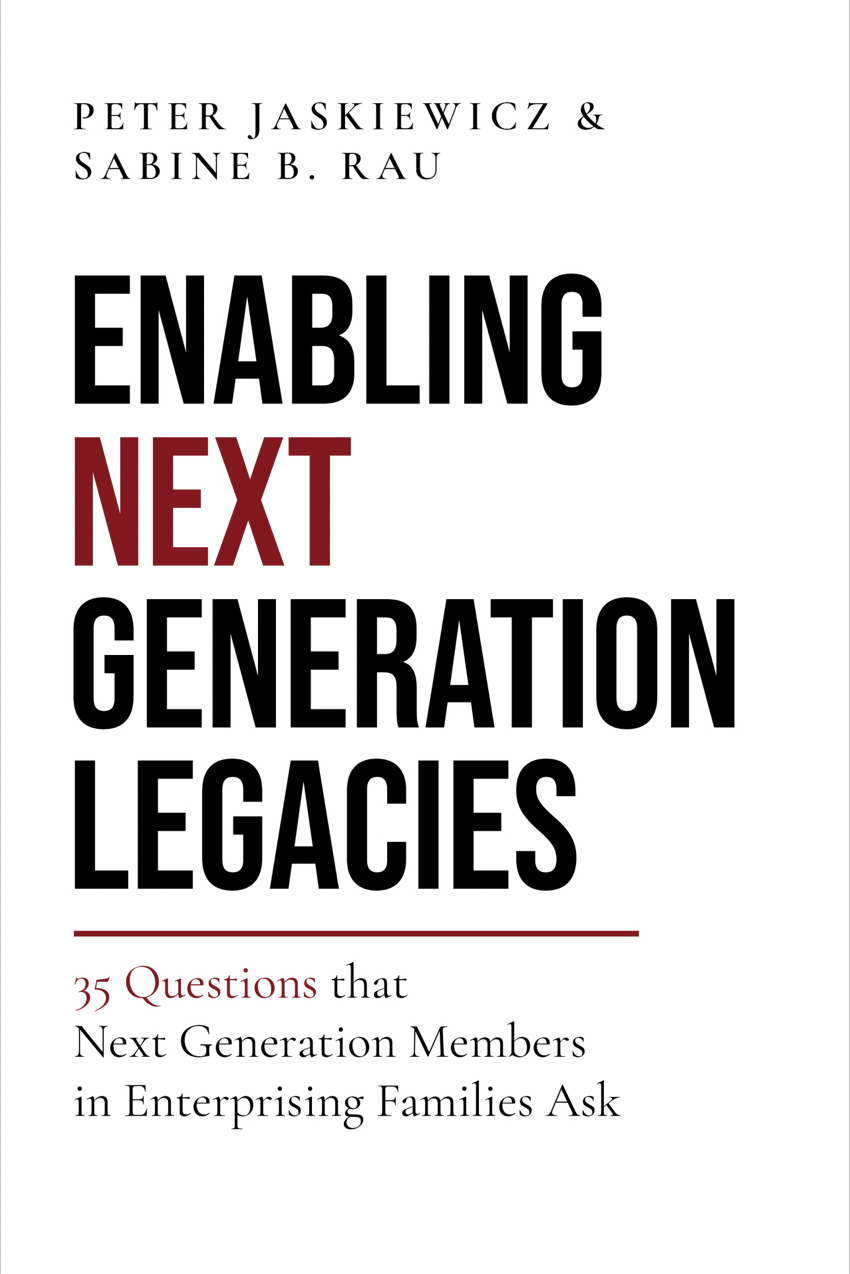
Enabling Next Generation Legacies: 35 Questions that Next Generation Members in Enterprising Families Ask

Answering the most pressing thirty-five questions of Next Generation members in a short and concise, yet competent way—leading academics, practitioners, and enterprising families come together to empower Next Generation legacies. Masterfully detangling the intricate dynamics of the family, ownership, business, and wealth, the authors share best practices, real-life examples, and critical questions for reflection.

2022
Au, K., Chen, X,K., Cheung, J., & Jen, M.
DC International: riding out of disruption as a third-generation successor

Ronald Chan was the third-generation heir apparent of a 70-year-old industry leader in Hong Kong. He joined the family-owned cycling business at its toughest time, and witnessed its sales tumble of nearly 50% due to different global crises. Before the COVID-19 pandemic hit, Ronald realized from the prior crises that their reliance on external supply of bicycles made them less responsive in the ongoing waves of disruptions. Hence, he suggested that the family create their own home-grown premium bicycle brand. The pandemic however suppressed the premium brand market, and Ronald needed to make a decision of whether he should detour to build a low-tier brand to meet the current demand, or continue with his plan for a high-end brand for long-term growth.

2022
Cheng, C.Y.J., & Au, K.
Maple Leaf Educational Systems: Creating new opportunities in the next normal of education.

2021
鄭宏泰、高皓
關鍵抉擇:華人家族企業的發展路徑

全球化走到十字路口,中國經濟也進入新的發展階段,如何在關鍵時刻做出關鍵抉擇,成為揚帆遠航的新起點,無疑極為重要。對於民營企業而言,接班問題一直備受關注,因為接班成功與否,直接關係家族和企業的命運。 香港的家族企業比內地民營企業的發展歷程更久,近年來相繼進入必須傳承接班的關鍵時刻。這些家族和企業的一言一行、一舉一動,包括投資動向、身體健康、感情寄託以及接班安排等,引發了社會各界的廣泛關注。 本書精選了吳光正家族、李嘉誠家族、鄭裕彤家族、廖創興家族、利希慎家族、何東家族、郭得勝家族等知名華人家族企業案例,進行多個維度的深入分析,研究其發展與接班的獨特挑戰與應對模式,為中華大地民營企業的現代化、國際化及基業長青提供借鑒。

2021
Cheng, C.Y.J., & King, R.
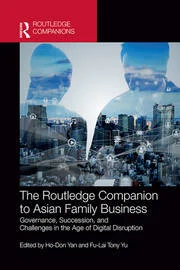
The Routledge companion to Asian family business: Governance, succession, and challenges in the age of digital disruption

This companion provides broad and in-depth insights into family business in Asia and how Asian family firms navigate in the digital economy. The first part of the book looks at key concepts of family business while the second part presents Asian family firms’ cases from Japan, South Korea, China, Taiwan, Hong Kong, Thailand, Malaysia and other Asian economies. This comprehensive reference will help readers understand how family firms in Asia compete and survive in the world market especially in the digital age and why and how Asian economies can emerge as one of the most dynamic regions in the world.

2021
Cheng, C.Y.J., &King, R.
Industry 4.0 andAsian family entrepreneurship: A career perspective

We examine how dynamic capabilities of a family firm to respond to technological disruptions, together with the next generation’s self-efficacy of effectuating change in the family business and their perceived abilities to assume an expanded role in relation to technological disruptions, may affect their career intentions in Industry 4.0. From our survey of 117 Asian next-generation family business members and three case studies, we showed the prevalence of a boundaryless career intention. We demonstrated that at a higher level of dynamic capabilities appears to raise the next-generation succession and boundaryless career intentions and reduce their employee and founding intentions. Next-generation members with higher perceived abilities exhibit a stronger intention to pursue a boundaryless career. Self-efficacy of effectuating change however does not predict any of the career intentions. We discuss implications for families-in-business and practitioners in next-generation career planning in Industry 4.0.

2021
鄭宏泰
何福堂家族:走在時代浪尖的風光與跌宕

走在時代浪尖的風光與跌宕 在香港歷史上,能富過三代、顯赫一時的家族不少,但能憑宗教、政治網絡與資本崛起壯大,家族成員又曾在不同層面取得多個第一的,唯何福堂家族而已: 第一位香港華人牧師 第一位香港華人立法局議員 第一位不靠科舉出任滿清高官的香港人 第一位同時擁有律師及醫生資格的香港人 第一位擁有英國律師資格的秀才 第一位獲大英皇室爵士頭銜的華人 第一位出任中國外交部長的香港人 第一宗子女狀告母親的爭產官司…… 這個傳奇家族已承傳六代、横跨二百年,在不同時代面對世界、中國及香港的變局,他們如何運用其獨有資本乘時而起?又是在甚麼情況下形勢急轉,助力變成阻力?興盛有時、衰落有時,如何拿揑家族才可以歷久長存?

2021
Au, K., & Chung, R
Mission Hills Group in China: Family entrepreneurship and legacy

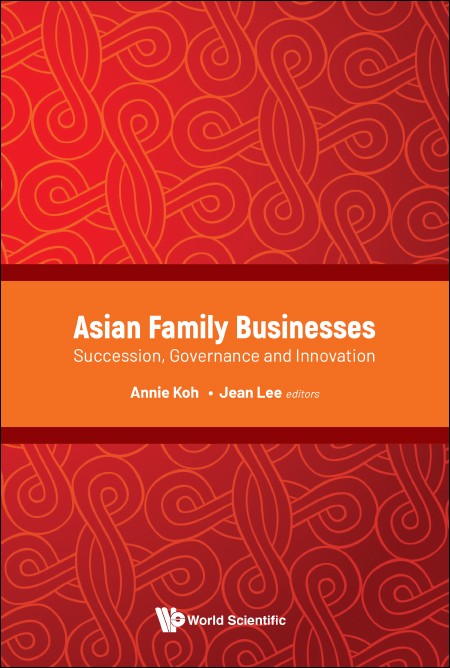
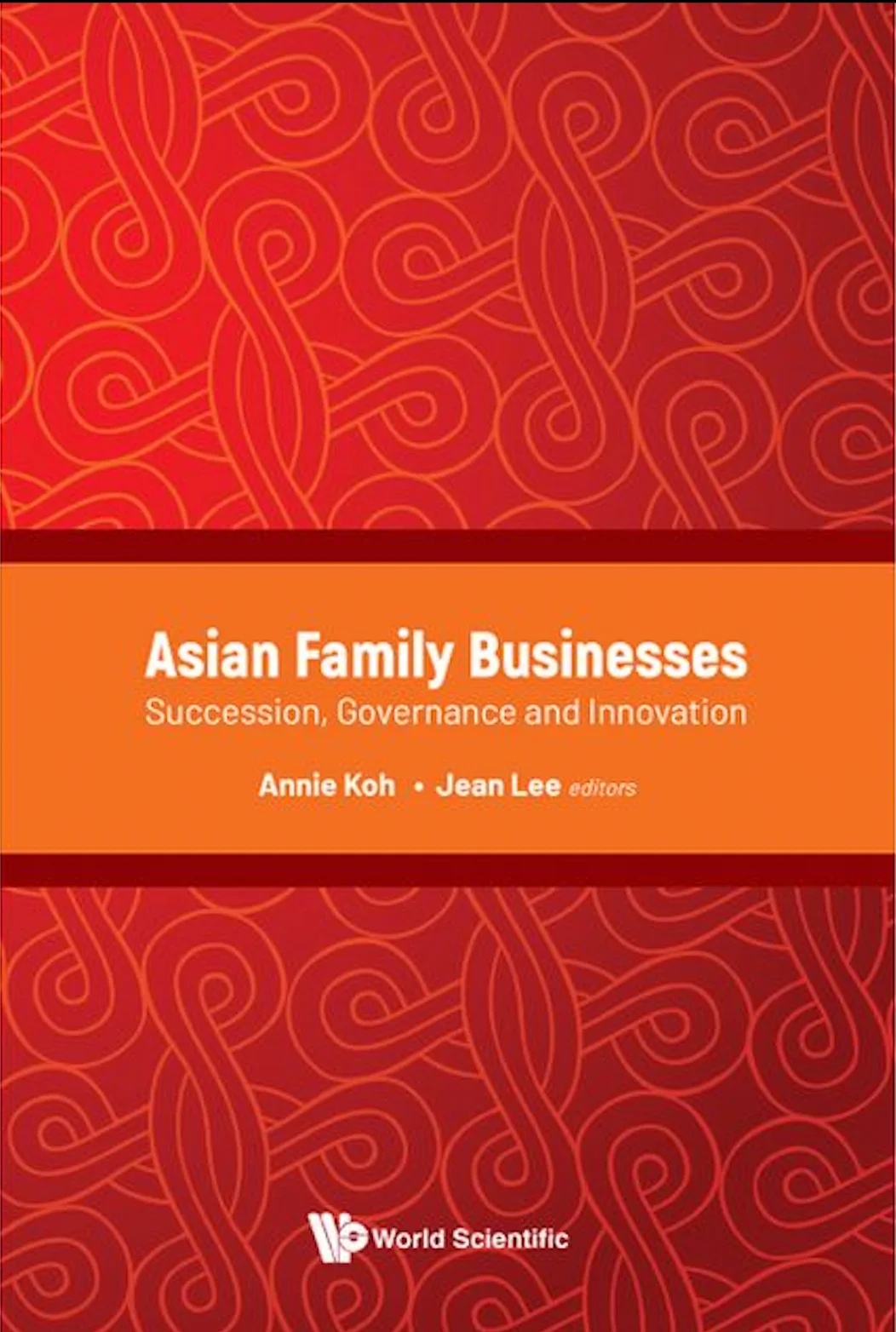
The global economy is predominantly driven by family businesses that provide the largest source of long-term employment in most countries. In Asia, family members amongst 60% of large corporations own a significant share of the equity and can influence key decisions. This phenomenon presents family enterprises with challenges and opportunities as any other non-family-run enterprise but in a more complex dimension. This book presents a collection of cases that address three key challenges faced by many of the family enterprises in Asia — Succession, Governance and Innovation. The narration of the cases also offers the reader tips about good practices among the Asian families, such as effective family governance mechanism, development of innovation and entrepreneurial mindsets across generations, and importance of family culture. This case book is essential reading for anyone interested in addressing the needs of business families in the region.

2021
Au, K., & Jen, M.
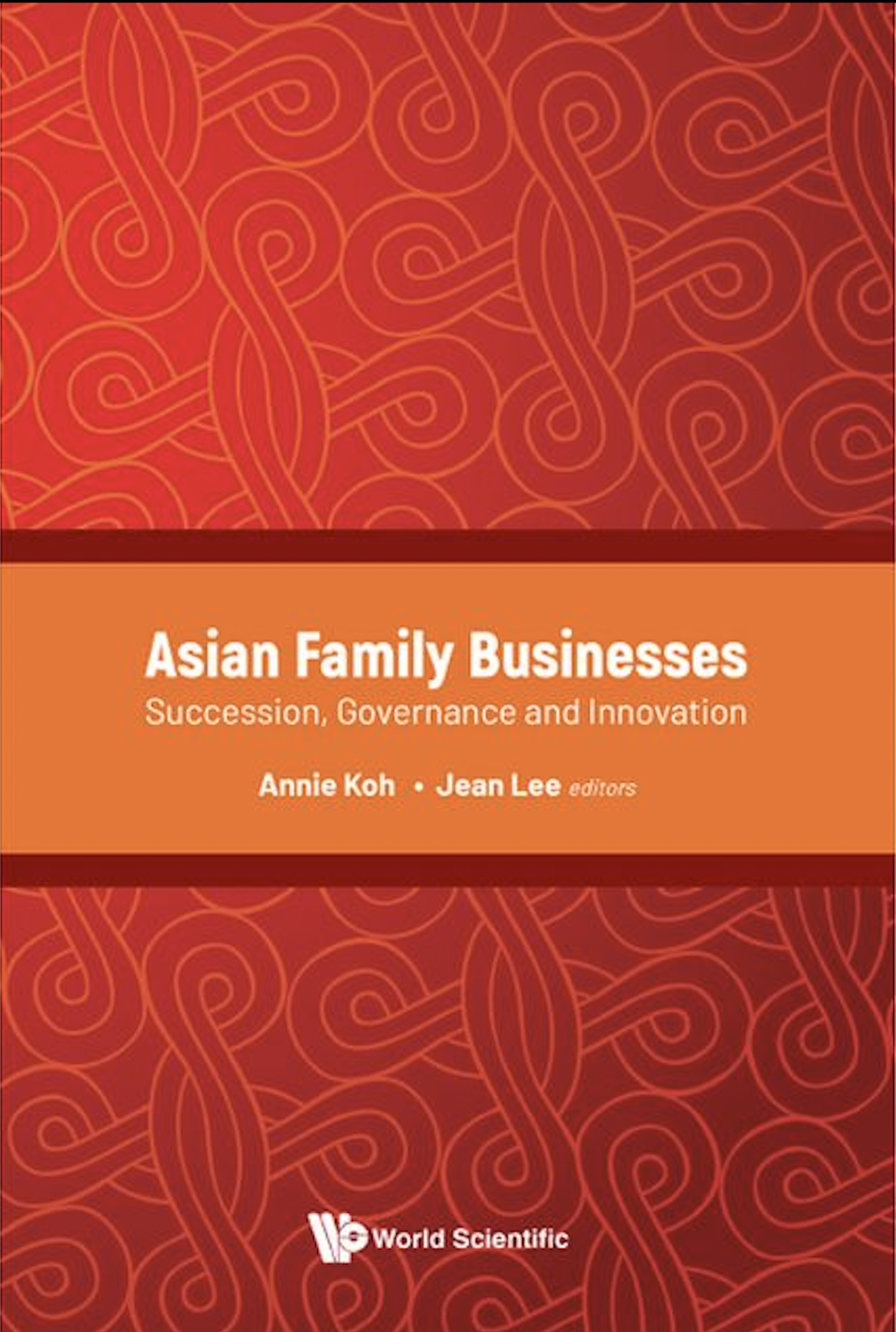
Asian Family Businesses: Succession, Governance and Innovation-LH Group Limited: Strategic renewal of a restaurant business by two second generations

The global economy is predominantly driven by family businesses that provide the largest source of long-term employment in most countries. In Asia, family members amongst 60% of large corporations own a significant share of the equity and can influence key decisions. This phenomenon presents family enterprises with challenges and opportunities as any other non-family-run enterprise but in a more complex dimension. This book presents a collection of cases that address three key challenges faced by many of the family enterprises in Asia — Succession, Governance and Innovation. The narration of the cases also offers the reader tips about good practices among the Asian families, such as effective family governance mechanism, development of innovation and entrepreneurial mindsets across generations, and importance of family culture. This case book is essential reading for anyone interested in addressing the needs of business families in the region.

2021
Hsi-Mei Chung, Kevin Au
Succession and Innovation in Asia’s Small-and-Medium-Sized Enterprises

This book documents the distinctive experiences and challenges of Small and medium-sized enterprises (SMEs) in Asia. By assessing succession and innovation in SMEs as the two sides of a coin, this book explains how innovations are essential to SMEs in succession. With detailed case examples, the book provides generalized solutions for SMEs to answer the question of how to make succession and innovation simultaneously successful. The authors discuss the potential solutions to solve the challenges of SMEs on succession and innovation by considering the utilization of the capital market, the electronic commerce strategy, the international strategy, and angel investment to pursue portfolio entrepreneurship, and compare these Asia solutions to the experiences from Europe. The book is recommended for family business and SME owners, professionals serving these firms, and the consulting firms that work on continuity issues of SMEs in Asia.

2021
Hsi-Mei Chung, Kevin Au
Succession and Innovation in Asia's small-and-medium-sized enterprises-Concluding remark: Remaining small and competitive or moving forward to scale up? Reflections and insights from the cases

This book documents the distinctive experiences and challenges of Small and medium-sized enterprises (SMEs) in Asia. By assessing succession and innovation in SMEs as the two sides of a coin, this book explains how innovations are essential to SMEs in succession. With detailed case examples, the book provides generalized solutions for SMEs to answer the question of how to make succession and innovation simultaneously successful. The authors discuss the potential solutions to solve the challenges of SMEs on succession and innovation by considering the utilization of the capital market, the electronic commerce strategy, the international strategy, and angel investment to pursue portfolio entrepreneurship, and compare these Asia solutions to the experiences from Europe. The book is recommended for family business and SME owners, professionals serving these firms, and the consulting firms that work on continuity issues of SMEs in Asia

2021
Au, K., & Jen, M.
Asian Family Businesses: Succession, Governance and Innovation- Mission Hills Group Limited: Family entrepreneurship and legacy

The global economy is predominantly driven by family businesses that provide the largest source of long-term employment in most countries. In Asia, family members amongst 60% of large corporations own a significant share of the equity and can influence key decisions. This phenomenon presents family enterprises with challenges and opportunities as any other non-family-run enterprise but in a more complex dimension. This book presents a collection of cases that address three key challenges faced by many of the family enterprises in Asia — Succession, Governance and Innovation. The narration of the cases also offers the reader tips about good practices among the Asian families, such as effective family governance mechanism, development of innovation and entrepreneurial mindsets across generations, and importance of family culture. This case book is essential reading for anyone interested in addressing the needs of business families in the region.

2021
Jen, M., Au, K., & Cheng, J.
How Do I Talk to My Friends and Colleagues About Our Wealth/Business Worth?

2021
Jen, M., Au, K., & Cheng, J.
How do I talk to my friends and colleagues about our wealth/business worth?

2021
Au, K., & Jen, M.
Asian Family Businesses: Succession, Governance and Innovation- Mission Hills Group Limited: Family Entrepreneurship and Legacy

The global economy is predominantly driven by family businesses that provide the largest source of long-term employment in most countries. In the Asian region, family members amongst the 60% of large corporations own a significant share of the equity and can influence key decisions. This phenomenon sets the family enterprises with various challenges and opportunities as any other non-family run enterprises but in a more complex dimension. This book presents a collection of cases that addresses three key challenges faced in many of the family enterprises in Asia; Succession, Governance and Innovation. The narration of the cases also offers reader tips about good practices among the Asian families such as effective family governance mechanism, development of innovation and entrepreneurial mindsets across generations, importance of family culture. This case book is essential reading for anyone interested in addressing the needs of business families in the region.

2020
Cheng, C.Y.J., & Au, K.
A unified theory of family and corporate governance.

2020
盧逸君、 區玉輝、 鍾喜梅、吳基逞
注意力觀點與專業邏輯的轉變?以會計師事務所之家族企業傳承服務為例

本研究以注意力觀點探討家族傳承業務如何影響會計師事務所的專業邏輯。以臺灣四大會計師事務所脫離傳 統服務,啟始家族傳承諮詢服務為標的,透過深度訪談與次級資料輔助,由實踐型取徑 (practice-based approach) 的注意力基礎觀點 (attention-based view; ABV) 爬梳一關鍵事件如何觸發產業參與者不同的注意力結構,進而導 致相異的實務作為 (practice) 與專業邏輯的變化。本研究發現,啟始需求在既有專業邏輯下的角色、專業服務提 供者與客戶間的關係,以及專業機構的組成決定組織的注意力結構,進而產生專業邏輯變化。從管理意涵的角 度,本研究提出專業機構未來服務模式的界定,亦點出內部管理與制度面的挑戰。

2020
King, R.,& Cheng, J.
Reframing succession in a disruptive era: A business family perspective

A new look at succession planning, from Hong Kong authors Roger King and Jeremy Cheng. Their article title refers to our unsettled times: ?Reframing succession in a disruptive era - a business family perspective?. The authors are concerned that the traditional views of succession - as in to whom the baton should be passed - are not sufficient for success in these changing times. They say they will ?demystify what a true family legacy means, which should not be the business per se, but the family's entrepreneurial DNAs, shared identity and values, and an enduring pool of resources?. Overall, they argue that the necessary evolution is from being a ?family business' to being a ?business family'. The article is carefully researched and contains a wealth of advice - including advice on expanding the role of a family office: We believe that with a much-needed ?upgrade' in their functionalities, family offices can catalyse the transition from a family business to a business family and enhance the odds of successful succession. While families set up their family offices primarily as a one-stop shop for wealth management, they should also embrace governance, education and social functions.

2020
Calabrò, A., Basco, R., Valentino, A., Cheng, J., Lavender, J., McGinness, T., Trimarchi, D., & Eli, M.
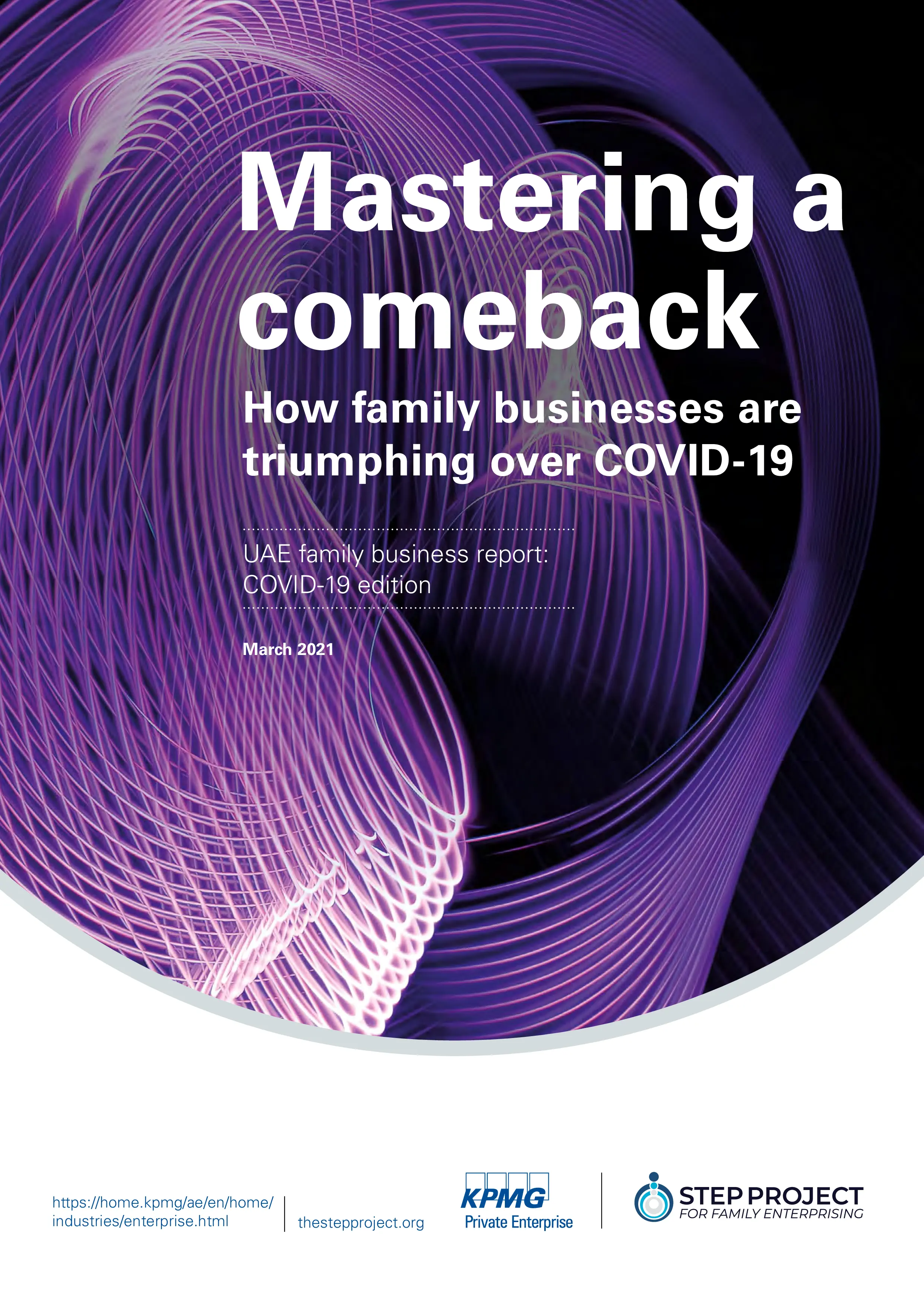
Mastering a comeback: How family businesses are triumphing over COVID-19

T here is a widely accepted view that family businesses have mastered the art of resilience, agility and adaptability to overcome whatever challenges may come their way. With this in mind, and for the benefit of all family businesses, we wanted to capture the valuable insights and important lessons learned by family business leaders throughout the world in guiding their businesses through the uncertainties of COVID-19.

2020
Fan, J.P., & Leung, W.S.
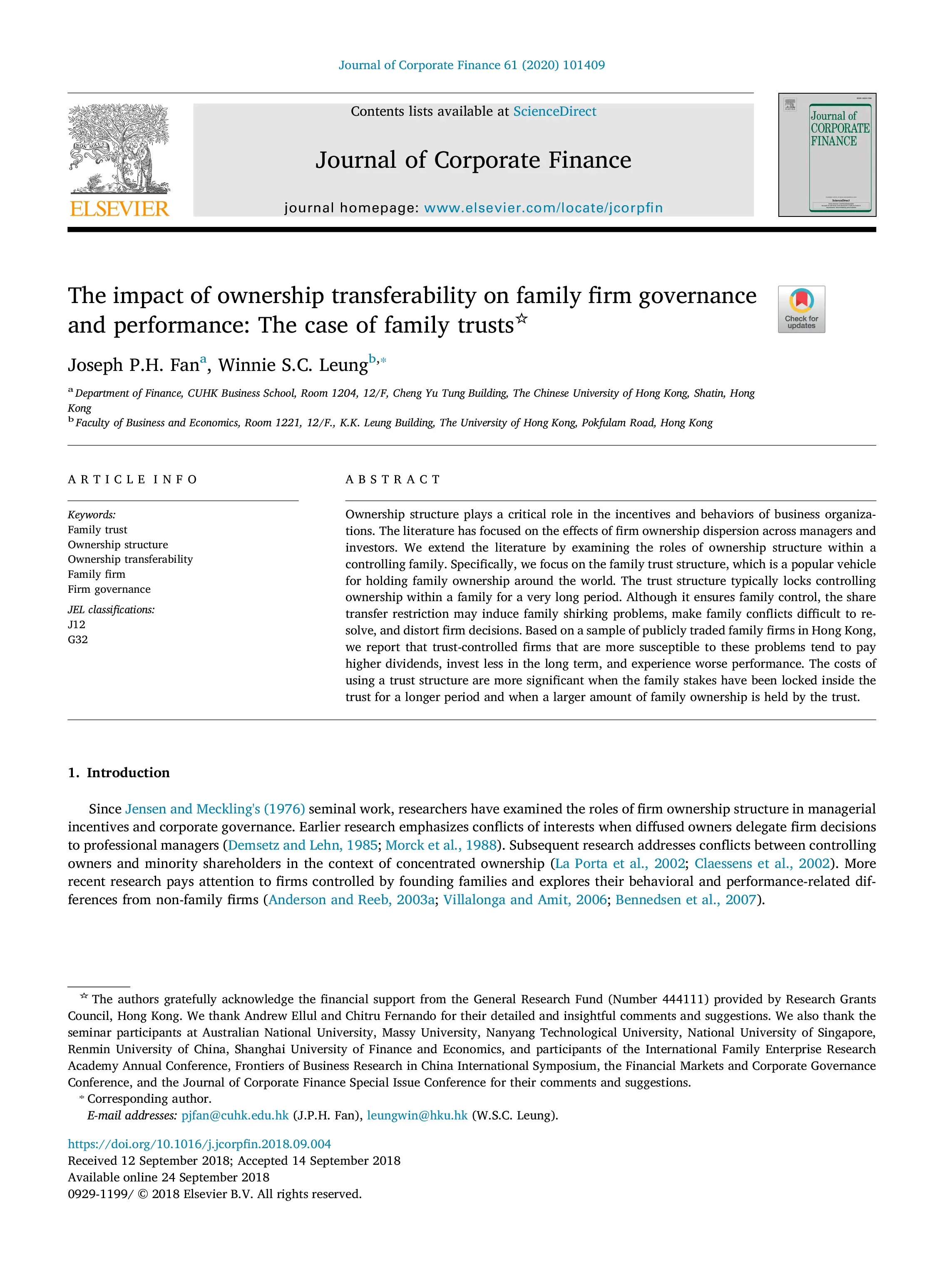
The impact of ownership transferability on family firm governance and performance: The case of family trusts

Ownership structure plays a critical role in the incentives and behaviors of business organizations. The literature has focused on the effects of firm ownership dispersion across managers and investors. We extend the literature by examining the roles of ownership structure within a controlling family. Specifically, we focus on the family trust structure, which is a popular vehicle for holding family ownership around the world. The trust structure typically locks controlling ownership within a family for a very long period. Although it ensures family control, the share transfer restriction may induce family shirking problems, make family conflicts difficult to resolve, and distort firm decisions. Based on a sample of publicly traded family firms in Hong Kong, we report that trust-controlled firms that are more susceptible to these problems tend to pay higher dividends, invest less in the long term, and experience worse performance. The costs of using a trust structure are more significant when the family stakes have been locked inside the trust for a longer period and when a larger amount of family ownership is held by the trust.

2020
Fan, J. P., & Leung, W. S.
The impact of ownership transferability on family firm governance and performance: The case of family trusts (Journal of Corporate Finance)

Ownership structure plays a critical role in the incentives and behaviors of business organizations. The literature has focused on the effects of firm ownership dispersion across managers and investors. We extend the literature by examining the roles of ownership structure within a controlling family. Specifically, we focus on the family trust structure, which is a popular vehicle for holding family ownership around the world. The trust structure typically locks controlling ownership within a family for a very long period. Although it ensures family control, the share transfer restriction may induce family shirking problems, make family conflicts difficult to resolve, and distort firm decisions. Based on a sample of publicly traded family firms in Hong Kong, we report that trust-controlled firms that are more susceptible to these problems tend to pay higher dividends, invest less in the long term, and experience worse performance. The costs of using a trust structure are more significant when the family stakes have been locked inside the trust for a longer period and when a larger amount of family ownership is held by the trust.

2020
Shen, N., Au, K., & Li, W.
Strategic alignment of intangible assets: The role of corporate social responsibility (Asia Pacific Journal of Management)

Intangible assets are becoming increasingly important to firms. However, the question of how firms can realize the full potential of intangible assets remains. We propose that corporate social responsibility (CSR) can help a company create value from intangible assets for two reasons. First, firms invest in CSR to increase employee loyalty, which in turn help retain knowledge workers. Second, firms engage in CSR activities to increase employees’ organizational identification, and to promote collaboration across units, which is crucial for the integration and alignment of intangible assets with other intangible assets and tangible assets. Moreover, we propose that institutional development may weaken the positive relationship between intangible assets and engagement in CSR, whereas product diversification may strengthen the relationship. Data analyses based on a sample of 4788 Chinese entrepreneurial firms provides support toward our main arguments. This study highlights a novel idea that firms may use CSR practices to realize the potential of their intangible assets. This study has important managerial implications as well.

2020
Au, K., & Tew, K. C.
LH Group Ltd.: Strategic renewal of restaurant business by two second generation

2019
Xiao, Y., Dowejko, M. K., Au, K., & Hsu, A. J.
“Jack-of-all-trades” with passion: Keener to pursue startup in a team? (Journal of Small Business Management)

This study tests the thesis of the “jack-of-all-trades” – whether individuals with a variety of skills are more likely to pursue entrepreneurship – at the early stage of venture formation. We also investigate if entrepreneurial passion would heighten the effect of a variety of skills to make would-be entrepreneurs keener to pursue the startup process and form new venture teams. Taking advantage of a 10-month entrepreneurship training project, we tested our propositions with a longitudinal sample of 215 participating waged employees. The findings show that skill variety positively influenced participants to form teams for new venturing in the program, and such effect was stronger among passionate individuals. Implications of the findings for human capital theory and entrepreneurial practice are discussed.

2019
Au, K., and Chung, R.
Konica Minolta Business Solutions (HK) Ltd.: Pioneering Corporate Social Entrepreneurship

This case can be used in an undergraduate- or graduate-level course on corporate social enterprising, shared-value initiatives, or international business. For the first two courses, this case illustrates how a multinational corporation can implement a shared-value project and scale it up. For an international business class, the case demonstrates how a subsidiary can interact with company headquarters to establish an innovative social business. After working through the case and assignment questions, students will be able to do the following: Analyze social innovation and corporate-value creation using the shared-value framework, and identify the elements that lead to successful implementation of a shared-value initiative. Describe various aspects of corporate social enterprising, such as leadership and organizational structure; mobilization of social, human, and financial resources; generation of profits; measurement of social impact; and relationships with designated communities. Illustrate the challenges facing corporate social enterprises in the context of a Hong Kong subsidiary of a Japan-based, publicly listed, multinational corporation. Explain how to manage the subsidiary-headquarters relationship with regard to social innovation and issues related to globalization-versus-localization and standardization-versus-flexibility. Differentiate between corporate social responsibility and creating shared value.

2018
鍾喜梅、區玉輝等編著
中小企業傳承與創新

傳承接班與創新成長在中小企業是一體兩面的決策,中小企業傳承順利,會使得各種有形與無形資本得以銜接,並依據產業的新競爭環境,成為支持企業創新與競爭的動力。 本書作者群先以亞洲不同國家的具體數據或案例,說明中小企業在傳承過程中,不同類型資本與企業創新之間關連,尤其是無形資本難以銜接對企業或產業的隱憂。其次,提出各種可能的解決方向以供思考,希望可以為中小企業在企業傳承與競爭優勢提升上,提供具體可行的建議。 面對傳承接班與創新成長的關鍵選擇,企業主若可以有多一些不同面向的思考,將有助於穩健企業傳承與發展之路。本書希望能提供提綱挈領與拋磚引玉之效,為中小企業傳承,提供深具學術基礎的務實建議。

2018
Thomas A. Birtch, Kevin Yuk-fai Au, Flora F. T. Chiang & Peter S. Hofman
How perceived risk and return interacts with familism to influence individuals’ investment strategies: The case of capital seeking and capital providing behavior in new venture financing (Asia Pacific Journal of Management)

Drawing on social capital and agency theories and using a multi-study research design, this study examined how perceived risk and return interacts with familism to influence individuals’ investment strategies in new venture financing, both capital seeking and capital providing behavior. We found that individuals high in familism are more likely to seek capital from and provide capital to family members than non-family members for new ventures. However, such relationships are more complex than prior research suggests because when individuals’ risk and return perceptions are included these interact with familism to differentially influence capital financing behavior directed at family versus non-family members. Contributions to theory and potential avenues for future research are discussed.

2018
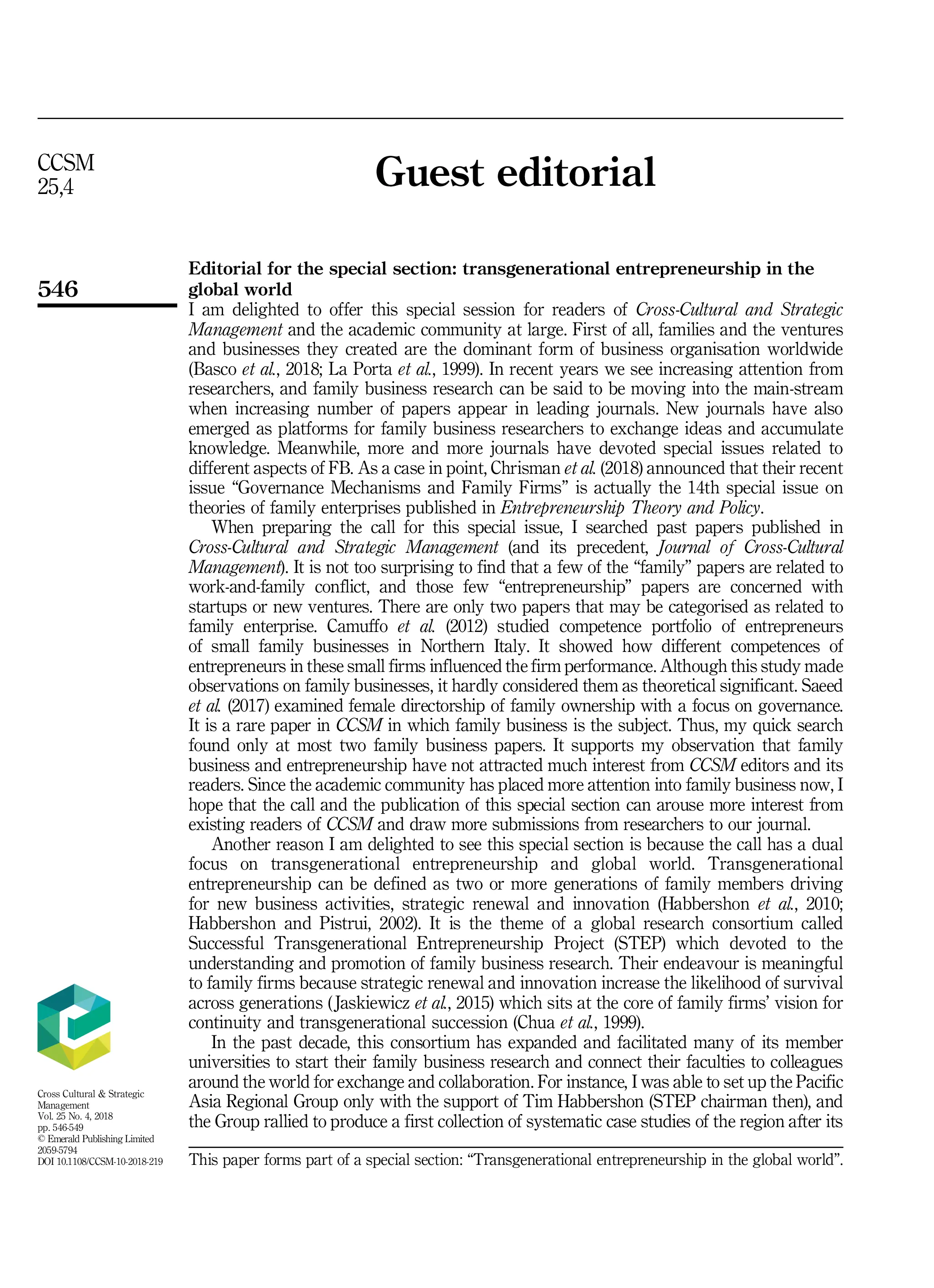
Kevin Au
Editorial for the special section: transgenerational entrepreneurship in the global world (Cross Cultural & Strategic Management)

2018
Na Shen, Kevin Au, Lan Yi
Diversification Strategy, Ownership Structure, and Financial Crisis: Performance of Chinese Private Firms (Asia-Pacific Journal of Financial Studies)

The relationship between diversification and firm performance varies among institutions and over time. Less is known about the advantageousness of diversification in economy-wide crises, which have occurred frequently in recent years. Using data on nearly 4000 Chinese private companies, we found that diversified firms performed better than focused firms during the recent global financial crisis. The diversification level was positively and linearly related to performance, that is, more diversified firms performed better. Moreover, we found that private firms that are totally owned by the founding owner and his/her family performed worse under crisis.

2018
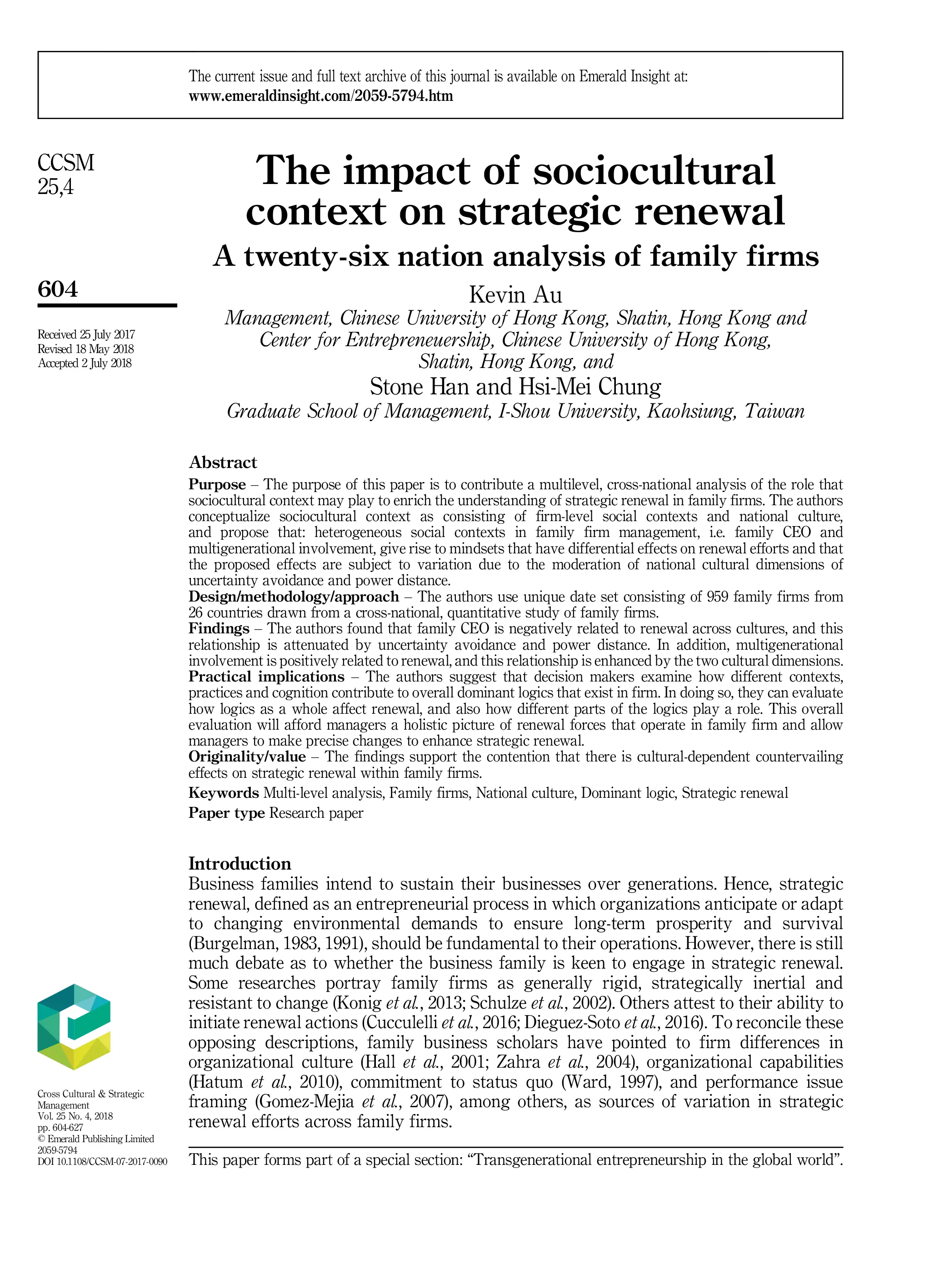
Au, K., Han, S., Chen, S.J., & Chung, H.S.
The impact of sociocultural context on strategic renewal: A twenty-six nation analysis of family firms (Cross Cultural & Strategic Management)

Purpose The purpose of this paper is to contribute a multilevel, cross-national analysis of the role that sociocultural context may play to enrich the understanding of strategic renewal in family firms. The authors conceptualize sociocultural context as consisting of firm-level social contexts and national culture, and propose that: heterogeneous social contexts in family firm management, i.e. family CEO and multigenerational involvement, give rise to mindsets that have differential effects on renewal efforts and that the proposed effects are subject to variation due to the moderation of national cultural dimensions of uncertainty avoidance and power distance. Design/methodology/approach The authors use unique date set consisting of 959 family firms from 26 countries drawn from a cross-national, quantitative study of family firms. Findings The authors found that family CEO is negatively related to renewal across cultures, and this relationship is attenuated by uncertainty avoidance and power distance. In addition, multigenerational involvement is positively related to renewal, and this relationship is enhanced by the two cultural dimensions. Practical implications The authors suggest that decision makers examine how different contexts, practices and cognition contribute to overall dominant logics that exist in firm. In doing so, they can evaluate how logics as a whole affect renewal, and also how different parts of the logics play a role. This overall evaluation will afford managers a holistic picture of renewal forces that operate in family firm and allow managers to make precise changes to enhance strategic renewal. Originality/value The findings support the contention that there is cultural-dependent countervailing effects on strategic renewal within family firms.

2018
Au, K., Howard Lam, Shi Yu Lu, and Icy Fong Lai Ngai
Bamboos Health Care (HK) Ltd.: Business Model and Expansion

This case can be used for senior undergraduate or graduate entrepreneurship or management courses. The case explores how the business model of a basic intermediary business can be developed into a highly profitable platform for the home market and become scalable to expand into adjacent markets or other countries. It offers students a great opportunity to learn the journey of a start-up using lean resources and risk mitigation with dis-intermediation and to consider solutions to minimize resistance to change in business. After completion of this case, students will be able to describe a business start-up process and journey; examine how to mitigate the risk of dis-intermediation as an intermediary platform business; and address decisions related to resistance to change from an incumbent successful business model.

2016
Shen, Na; Au, Kevin; Birtch, Thomas
The Performance of Chinese Private Firms in Coping with a Global Financial Crisis: Who Is Best Positioned? (Frontiers of Business Research in China)

Using organizational flexibility as a research lens, we investigate how private firms, especially SMEs, in China cope with the 2008 financial crisis. Testing data from a large sample of private firms (N=3,459) by difference-indifferences analysis, we find that firms with industrial diversification, geographic expansion and political connections perform better during the crisis than those without. These results are less affected by self-selection problems (as the abrupt crisis provides a natural experiment) and hold up against endogeneity and several other challenges in robustness tests. The findings offer important implications for researchers, business owners, policy makers and future research.

2016
Joseph P. H. Fan, Li Jin & Guojian Zheng
Revisiting the Bright and Dark Sides of Capital Flows in Business Groups (Journal of Business Ethics)

Prior studies report that the business group structure and the associated intra-group capital flows are prone to conflicts of interest between controlling shareholders and minority investors. Yet business group is a prevalent and stable structure around the globe, particularly where capital markets are underdeveloped. Using data from China, this paper empirically studies the trade-off between the negative and positive roles played by intra-group capital flows and tests the efficiency implications of such trade-off. We find that from the perspective of the whole group, intra-group capital flows are most efficient when the groups are least subject to conflicts of interest between controlling shareholders and minority shareholders and when they face strong external financing constraints.

2015
Bennedsen. M., Fan. J. P. H., Henry., B, & Wiwattanakantang. Y.
Yung Kee: A Family Feud Divides Hong Kong

The Kam family has owned Yung Kee, a huge 750-seat restaurant in Hong Kong, for more than 50 years. Starting out as a food stall, the business still 'packs them in' today. However, soon after the death of the patriarch, at the age of 96, in 2004, his two oldest sons became embroiled in a bitter and very public family feud over the restaurant's management and the family fortune, estimated to be worth HK$2 billion.

2015
Morten Bennedsen, Joseph P.H. Fan, Ming Jian, Yin-Hua Yeh
The family business map: Framework, selective survey, and evidence from Chinese family firm succession (Journal of Corporate Finance)

This paper analyzes the causes and consequences of founding family engagement in firm ownership and management. We hypothesize that families manage their firms because they are able to make contributions that non-family managers cannot provide. However, roadblocks arising from within the family, from markets, and from surrounding institutions challenge family ownership. We propose a new framework for organizing these assets and roadblocks, called the family business map; this framework is useful for categorizing the papers presented in this Special Issue. We support the predictions of the framework with evidence from Chinese family firm succession, and conclude that family firm organization is an adaptation to environmental opportunities and constraints. We end the paper with suggestions for future research.

2015
Weiwen Li, Kevin Yuk-fai Au, Ai He & Lihong Song
Why Do Family-controlled Firms Donate to Charity? The Role of Intrafamily Succession Intention, Social Status, and Religiosity (Management and Organization Review)

Drawing on expectancy theory and the socioemotional wealth (SEW) perspective, we propose that family owners with intrafamily succession intention are more motivated to accumulate or preserve SEW. As corporate philanthropy is a critical way for family-controlled firms to accumulate or maintain SEW, family owners with intrafamily succession intention are more likely to engage in corporate philanthropic activities. Data on a nationally representative sample of family-controlled firms in China support our prediction. We also find that the relationship between intrafamily succession intention and corporate philanthropy is moderated by family owners’ social status and religiosity. The findings contribute to our understanding about family businesses, in general, and those in China, in particular, as well as the SEW perspective.

2015
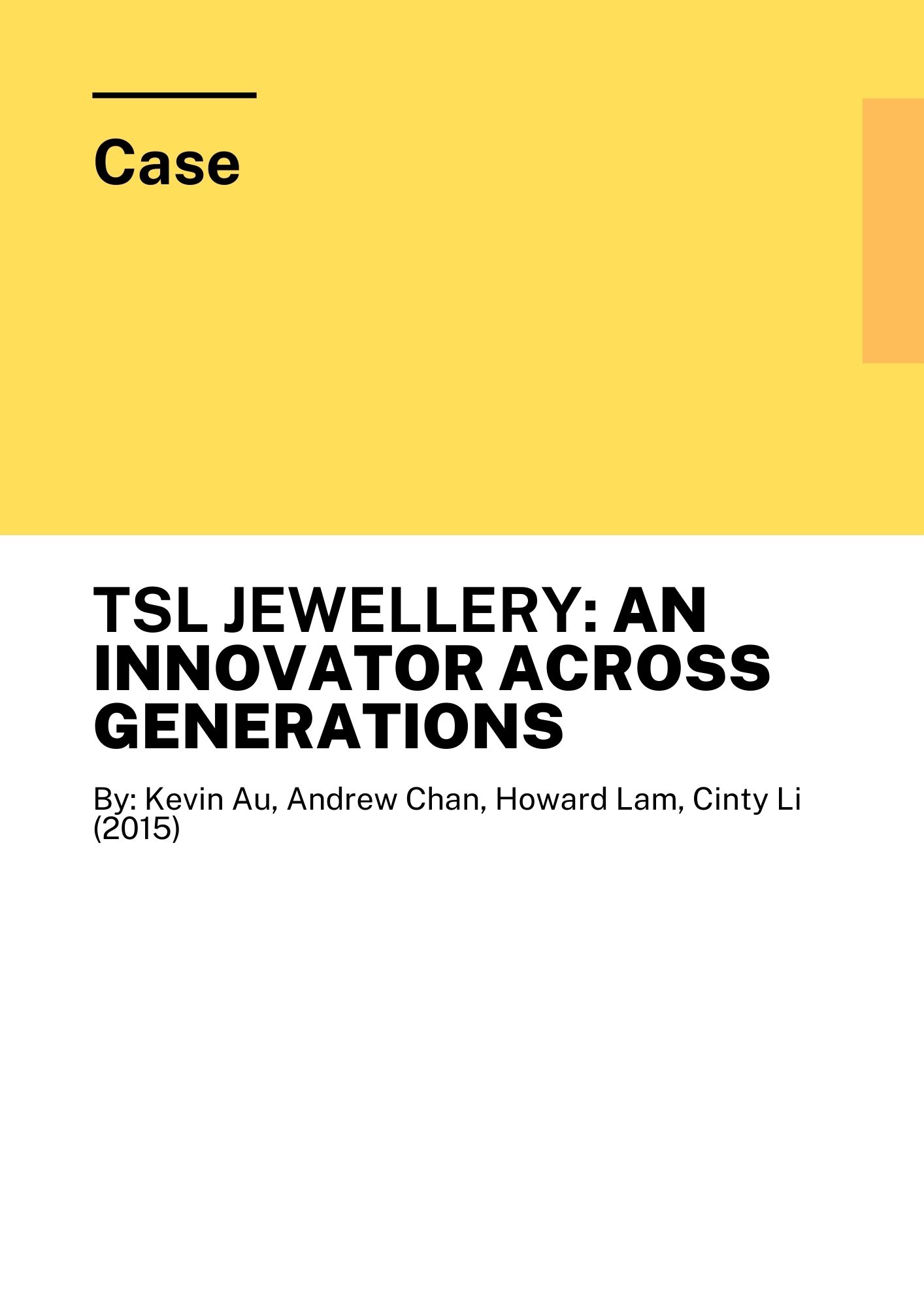
Au, K., Chan, C. F., & Lam, H.
TSL Jewelry: An Innovator across Generations

The case focuses on brand building and the turnaround of a family business. It can be used to teach students about:Family dynamics in a trans-generational family business, and the introduction of non-family professionals to a family business.How revitalizing a brand can transform a business.Understanding leadership challenges when a family business continues to expand.This case is relevant to graduate-level courses in entrepreneurship, family business, leadership, marketing and general management.

2015
莫顿·班纳德森, 范博宏
家族企业规划图

本书为家族企业提供了一个独特的规划框架和新颖的规划工具,该框架和工具已被每个大洲成百上千的家族企业成功运用。我们的目的在于改善家族企业的长远规划,并帮助他们迎接代代传承过程中的挑战。

2015
莫顿·班纳德森, 范博宏
接班人計劃: 決定家族企業未來20年最重要的生存之鑰

辛苦經營大半生的公司,該由誰繼續承接? 是家族繼承人?或是職業經理人? 選賢或選能?品牌精神如何延續? 接班人將是你未來最關鍵的企業議題! 自經濟起飛之後至今,許多第一代的台灣創業家撐起了台灣的經濟,卻也開始步入晚年,理應開始找尋接班人傳承延續。 然而,我們卻見到許多企業家,至今年事已高卻仍艱辛站在最前線率兵打仗,為何? 實在是接班人難尋! 究竟該如何選擇接班人?你的企業品牌如何延續?又,你企業最重要的無形資產是什麼?你該如何規劃你的傳承之路?股權分配的問題你考慮過了嗎?接班後又該怎樣安撫下面的元老與經理人? 這許多的問題一在糾纏著現在許許多多的企業主們,讓他們不知如何找起,只好如古時三國黃忠,勉勵自己「老當益壯」,持續帶頭衝鋒,如張忠謀,至七八十歲才交出執行長的位置,卻也掛名董事長,無法放心交棒。 范博宏教授在此書中匯總了國內外大大小小的企業案例,為如今茫然失措的企業主們擘劃出一條明路。他指出,一個企業要能夠順利接班,必須提前二十年做準備,才有機會讓企業永續長青。 本書除了為你分析出影響企業長期所有權與經營模式的因素外,更提供一套完整的「企業長青地圖」,協助你妥善規劃,選擇自己最適合的傳承模式。 你將在其中學會找出企業最重要的傳承資產為何?常見的阻礙是什麼?並且從案例中看見一流的企業的接棒方式、後續的治理要點,甚至是較少人會顧及到的股權設計。 吉姆‧柯林斯在其著作中曾說「偉大公司的創辦人是造鐘,而非報時」,一家偉大的企業要能夠屹立不倒,永續發展,並非僅靠自己的一己之力,能夠找出最重要的那一位接班人,將是每一個企業最重要也最不能忽視的關鍵!

2015
Bennedsen, M., & Joseph Fan
The Family Business Map

This paper analyzes the causes and consequences of founding family engagement in firm ownership and management. We hypothesize that families manage their firms because they are able to make contributions that non-family managers cannot provide. However, roadblocks arising from within the family, from markets, and from surrounding institutions challenge family ownership. We propose a new framework for organizing these assets and roadblocks, called the family business map; this framework is useful for categorizing the papers presented in this Special Issue. We support the predictions of the framework with evidence from Chinese family firm succession, and conclude that family firm organization is an adaptation to environmental opportunities and constraints. We end the paper with suggestions for future research.

2014
Cheng, J., Ho, F., & Au, K.
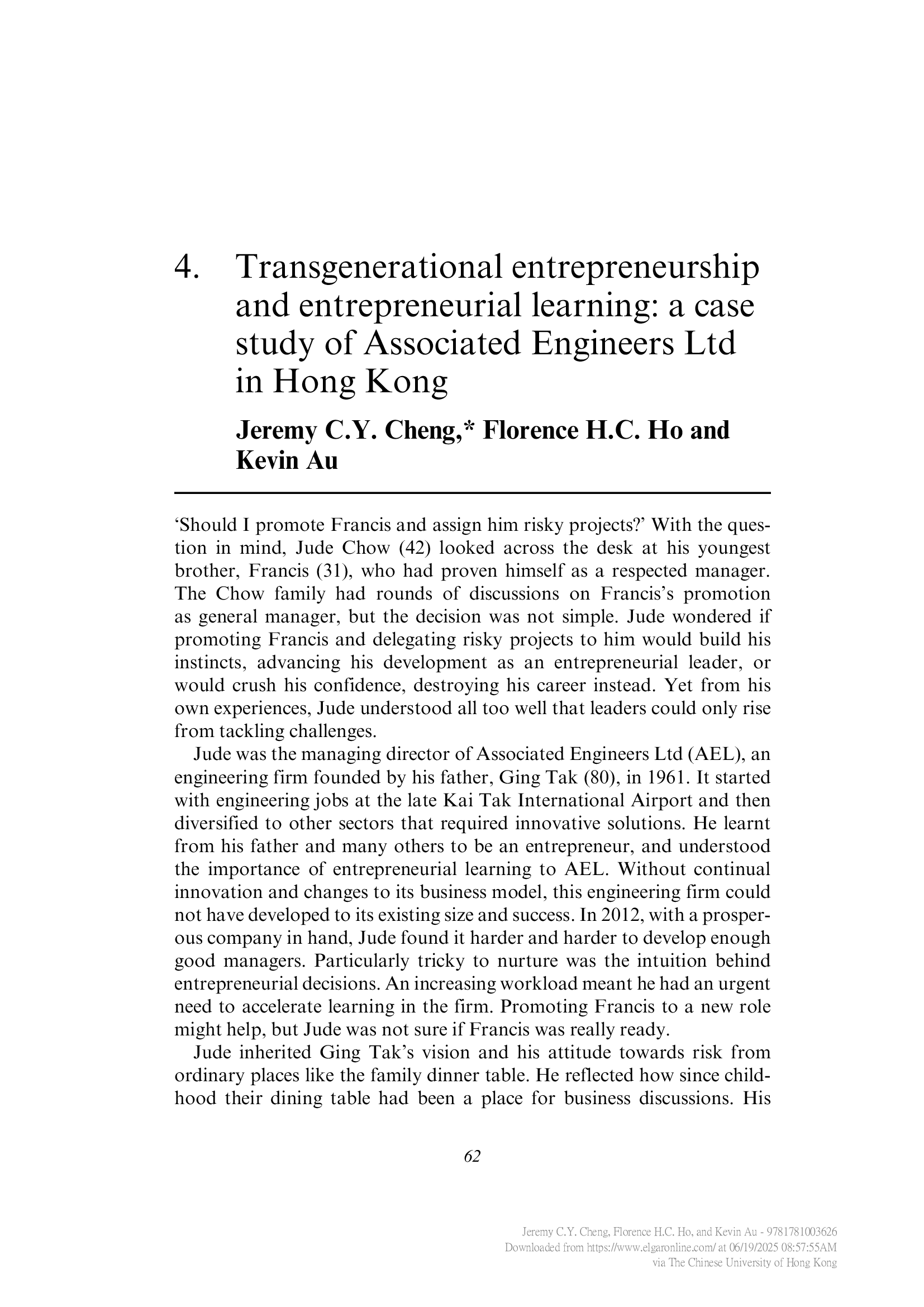
Transgenerational Entrepreneurship and Entrepreneurial Learning: A Case Study of the Associated Engineers, Ltd. in Hong Kong

‘Should I promote Francis and assign him risky projects?’ With the ques- tion in mind, Jude Chow (42) looked across the desk at his youngest brother, Francis (31), who had proven himself as a respected manager. The Chow family had rounds of discussions on Francis’s promotion as general manager, but the decision was not simple. Jude wondered if promoting Francis and delegating risky projects to him would build his instincts, advancing his development as an entrepreneurial leader, or would crush his confidence, destroying his career instead. Yet from his own experiences, Jude understood all too well that leaders could only rise from tackling challenges.

2014
Cheng, C. Y. J., & Au, K.
Luen Thai: Governance for the Tan’s shared future. Coutts Prize for Family Business Hong Kong

2014
Cheng, C. Y. J., & Au, K.
The Mok family: Challenges to Automatic Manufacturing Limited in Hong Kong. Coutts Prize for Family Business Hong Kong

Automatic Manufacturing Limited (AML) is a pioneer among manufacturers in Hong Kong. It has become known for high- quality manufacturing and refrains from price competition. Its success, to a great extent, can be attributed to the eff ective governance and management systems it has built to promote excellence in learning and innovation. This chapter fi rst describes the structures and processes that contribute to AML’s outstanding performance and then examines the system that the founding family has created to foster the entrepreneurial spirit in the next generation. This system has three distinguishing features: (1) it provides the incentive as well as a launching pad for the incoming generation to take risks and grow as independent entrepreneurs; (2) it gives willing AML employees the opportunity to join the spin- off ventures of the incoming generation; and (3) it forms part of an integrated plan to enable the incoming generation eventually to take the helm at AML.

2014
Cheng, J., Au, K., & Ho, F.
Entrepreneurial learning journey to the CEO suite: Case of a second generation family member in a Chinese family firm

2013
區玉輝、宋麗紅
中國家族企業社會責任報告2013

《中國家族企業社會責任報告》是中國民(私)營經濟研究會家族企業委員會所撰寫的第一份中國家族企業社會責任報告,報告分為上下兩篇,上篇為調查與報告,下篇為實例與點評,展示了家族企業在整個大中華地區承擔社會責任的現狀與歷史,對中國家族企業承擔社會責任有一個真實客觀的描述與歷史。

2013
Pramuan Bunkanwanicha, Joseph P. H. Fan and Yupana Wiwattanakantang
The Value of Marriage to Family Firms (Journal of Financial and Quantitative Analysis)

This paper presents the first empirical evidence showing that the marriage of a member of the controlling family adds value to public corporations. The results, based on a uniquely comprehensive data set from Thailand, show that the family firm's stock price increases when the partner is from either a prominent business or a political family. Abnormal returns tend to be higher for firms whose operation depends on extensive networks. In contrast, marriages to ordinary citizens are not associated with any abnormal returns. These findings are generally supportive of the value of networks in general and marriage in particular.

2013
Kevin Au, Flora Chiang, Thomas A Birtch, Zhujun Ding
Incubating the next generation to venture: The case of a family business in Hong Kong (Asia Pacific Journal of Management)

Many Chinese family businesses face the dilemma of building good operating and governance structures and systems while fostering an entrepreneurial spirit across generations. In this study, we explored trans-generational entrepreneurship in Automatic Manufacturing Ltd. (AML), a Hong Kong SME, to shed light on this problem. The first generation founded the company and chose a unique development path that emphasized quality, innovation, and learning before grooming a cadre of professional managers. To continue the family entrepreneurial spirit, AML used the “familiness” resources embodied within the family and its business to incubate the second generation. To test the wings of the second generation as entrepreneurs and then lure them back to AML to take over the responsibilities of the first generation, a unique succession plan nurturing spin-offs by the second generation was developed and implemented. Such a systematic approach, although still under experimentation, has the potential to become best practice for other family businesses. The implications of this approach for research in portfolio entrepreneurship and open innovation are also discussed.

2013
Yuan Lu, Kevin Au, Mike W. Peng, Erming Xu
Strategic management in private and family businesses (Asia Pacific Journal of Management)

This Special Issue, taking five years to come to fruition, presents the latest research on strategic management in private and family businesses in Asia Pacific regions. Asia Pacific societies have a long history of private and family businesses. For example, a Chinese classic, Records of the Grand Historian (known by its Chinese name Shiji, which was written from 109 BC to 91 BC), includes a chapter, “Biographies of Usurers” (Huozhi liezhuan), which describes private business people such as merchants and handcraftsmen over 2,000 years ago. During China’s Qing Dynasty (1644 to 1912), Chinese money merchants, who usually received investments from family members, already established subsidiaries in Japan. In India, Tata Group, established in 1860, is regarded as the number one family business in terms of size and scope. In Japan, a majority of large corporations today, such as Toyota and Suzuki, were actually developed from traditional family businesses.

2013
Cheng, C. Y. J., Ho, H. C. F., & Au, K.
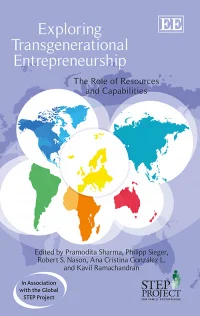
Exploring Transgenerational Entrepreneurship: The role of resources and capabilities

Transgenerational entrepreneurship, as a discipline, examines the processes, resources and capabilities that allow family enterprises to create social and economic value over time in order to succeed beyond the first generation of business owners. While tangible resources such as financial and physical capital are certainly important factors in the long-term success of a family-run business, this book focuses specifically on the role of intangible resources and capabilities, which are less easily quantifiable but equally vital.

2012
鍾喜梅、區玉輝等編著
關鍵世代︰走出華人家族企業傳承之困

經過30多年的發展,中國的民營經濟發展已進入新舊交接的階段,今後將有一波波的企業家退休,將企業與家族財富交托給下一代。但是他們的下一代沒有經驗,而且面臨高度不確定的商業環境。從過去東亞商業家族交棒的經驗中我們知道,中國人的家業傳承挑戰很大,企業與家族的財富與價值觀往往在家族斗爭與後繼無人的不堪境況中潰散。如何安排企業接班,傳承家族有形與無形價值,是令多數商業家族頭疼的問題。 作者範博宏以平易的筆觸與豐富的案例介紹基業長青問題的最前沿思想與研究發現,包括如何發掘家族經營事業的特殊優勢、如何傳承家族理念等無形資產、如何設計與分配家族股權、如何設置執行整合家族意見的家族治理機制、如何培養事業接班人、如何激勵職業經理人、如何實踐永續經營的公司治理等。 《關鍵世代︰走出華人家族企業傳承之困》強調科學客觀的分析,以世界的視角看中國的問題,借鑒西方與東亞華人商業家族的經驗為中國大陸的民營企業家族找到永續之道。盡管家家有本難念的經,但是尋求家族共同價值、部署並執行保存家族價值的制度,並以此價值影響企業、造福社會,的確有共通的方法。 最後,《關鍵世代︰走出華人家族企業傳承之困》提醒中國企業家、家族成員與企業員工們︰基業長青需要作長期的準備,而且許多決定不能在短期逆轉。所以,趁年輕,從今天起就開始準備!

2011
Fan, J. P.-H., Wong, T. J., & Zhang, T.
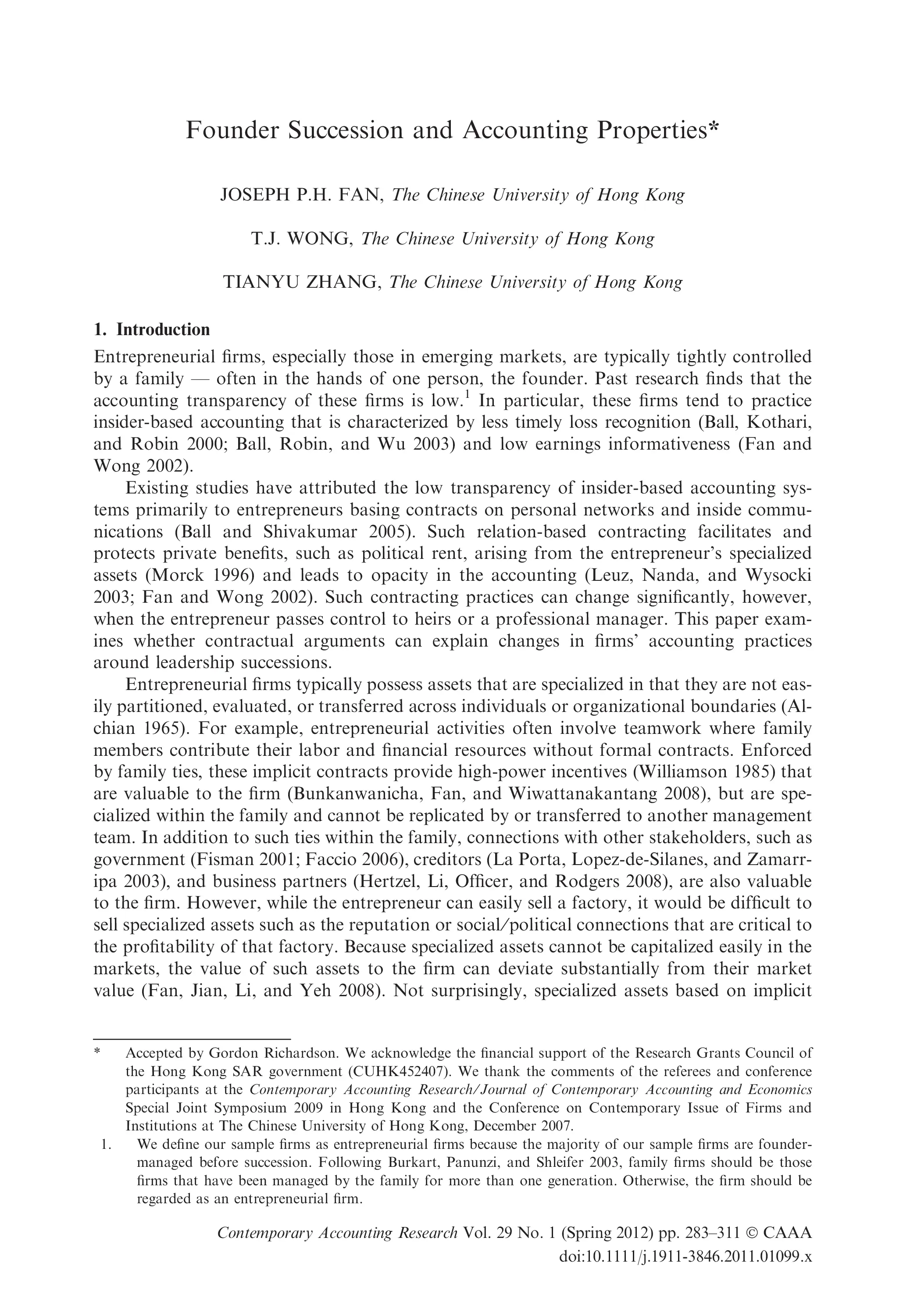
Founder Succession and Accounting Properties (Contemporary Accounting Research)

Entrepreneurial firms, especially those in emerging markets, are typically tightly controlled by a family — often in the hands of one person, the founder. Past research finds that the accounting transparency of these firms is low.1 In particular, these firms tend to practice insider-based accounting that is characterized by less timely loss recognition (Ball, Kothari, and Robin 2000; Ball, Robin, and Wu 2003) and low earnings informativeness (Fan and Wong 2002).

2011
Au, K., Craig, Justin, & Ramachandran, K.
Family Enterprise in the Asia Pacific: Exploring Transgenerational Entrepreneurship in Family Firms

This book analyzes the findings reported in the first Asia Pacific summit of the Successful Transgenerational Entrepreneurship Practices (STEP) project. Researchers in Australia, China, and India discussed eleven in-depth case studies to shed light on the challenges that business families and family businesses faced in continuing and extending their entrepreneurial capabilities across multiple generations. Based on a common research framework from STEP, each chapter introduces key findings and challenges existing theory, offering answers to two broad questions in the Asia Pacific context: How do business families and family businesses generate and sustain entrepreneurial performance across generations and how does entrepreneurial performance relate to the continuity, growth and transgenerational entrepreneurship of business families and family businesses? In doing so, the authors look at key issues faced by family business including dealing with communication issues across generations, resolving conflict between siblings, preparing and luring younger generations back to family business, and professionalization of business. The chapters go beyond the succession and governance challenges and explore the processes and outcomes of entrepreneurship in the Austral–Asian family context. Academics, teachers and students in business and management, entrepreneurship and family business, and Asian studies will find this path-breaking book of great value, as will libraries, policymakers and consultants.

2009
Au, K. & Li, B.
Ho Tak Kee Book Co Ltd - A Third Generation at a Crossroads (A) & (B)

Ho Tak Kee, originally a professional publisher and printer that started back in the 1950s in Hong Kong, faced static performance for decades. This forced the founder and grandfather of the family to decide to close down the printing department. This decision pushed his youngest son, On-ping, to a critical point resolving whether and how to continue the family business. Under pressure, On-ping turned to his son John for support but the request put John in a difficult position of choosing between a professional career and the family business. As a young man without much life and work experience, John had to go through a personal development process to shape up as a leader to be able to make the family business thrive again and keep the family together, while formulating his entrepreneurial vision for the future of the business and family. Case (A) runs from John''s point of view as his is making his decison and is intended to stimulate students to look at a family business from a third generation''s perspective. Case (B) starts with John''s decision to join Ho Tak Kee.

2009
Chung, H.-M., Thomsen, S., & Au, K.
Foundation ownership enhances longevity in Taiwan family firms: Implications beyond family control

The Platform for Family
Enterprise Excellence

Thank you! Your submission has been received!
Oops! Something went wrong while submitting the form.